Book Smart vs. Street Smart Is a Comforting Story — Cognitive Science Doesn't Buy It

Photo: Gannu03, CC BY-SA 4.0, via Wikimedia Commons
Book Smart vs. Street Smart Is a Comforting Story — Cognitive Science Doesn't Buy It
You know the script. Someone aces every test but can't figure out how to parallel park or read a room. Someone else never went to college but built a business from nothing and seems to understand people intuitively. The observation practically writes itself: "She's book smart, but he's street smart."
It's one of the most socially durable ideas in American culture — a way of sorting people that manages to flatter almost everyone. Struggling academically? You've got street smarts. High GPA but socially awkward? Book smart. The framework is generous that way. It offers nearly every person a category where they can feel capable.
The problem is that cognitive science doesn't really support the clean division. The way intelligence actually works is messier, more interconnected, and considerably more interesting than the two-box model suggests.
Where the Dichotomy Came From
The book smart/street smart split isn't the product of a single source — it's more of a cultural accumulation. Several threads fed into it.
Howard Gardner's 1983 book Frames of Mind introduced the theory of multiple intelligences, proposing that human cognitive ability spans several distinct domains: linguistic, logical-mathematical, musical, spatial, bodily-kinesthetic, interpersonal, intrapersonal, and naturalistic. Gardner's intent was to challenge the idea that IQ captured everything important about human cognition.
 Photo: Howard Gardner, via m.media-amazon.com
The problem is that popular culture grabbed the concept and ran somewhere Gardner never intended. "Multiple intelligences" became shorthand for the idea that everyone is smart in their own way — which sounds inclusive but quietly dismantles the idea that some cognitive skills are more demanding than others. The nuanced academic argument got flattened into bumper-sticker psychology.
Self-help publishing did the rest. By the 1990s and 2000s, books promising to unlock your "emotional intelligence" or "practical wisdom" had created a market for intelligence frameworks that made readers feel validated rather than challenged. The book smart/street smart dichotomy fit neatly into that ecosystem.
What Cognitive Science Actually Says
Researchers who study intelligence for a living tend to be skeptical of clean dichotomies — and for good reason.
The concept of general intelligence, often called g, has been one of the most replicated findings in psychology. People who perform well on one type of cognitive task tend to perform better across a wide range of cognitive tasks. This doesn't mean everyone is good at everything — individual variation is real and large. But it does suggest that cognitive abilities aren't as neatly separable as the book/street divide implies.
More directly relevant: studies looking at "practical intelligence" — the kind of real-world problem solving that "street smarts" is supposed to capture — have found it correlates meaningfully with general cognitive ability. In other words, the person who navigates complex social situations skillfully, figures out how to fix things without a manual, or builds a business from intuition is typically also deploying significant cognitive horsepower. It just doesn't look like a test score.
Robert Sternberg, a psychologist who spent decades studying what he called "successful intelligence," found that analytical ability (the book smart kind), creative ability, and practical ability are all related and tend to appear together in high-performing individuals. His research challenged the idea that you're either one or the other. Most people who excel in real-world contexts are strong across multiple dimensions — not because they traded one skill for another.
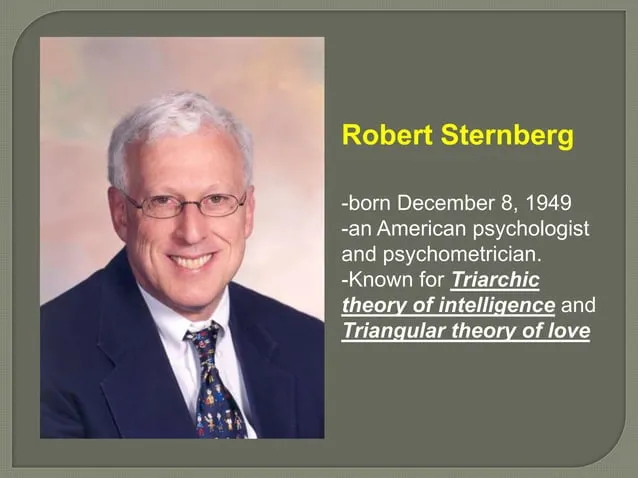 Photo: Robert Sternberg, via image.slidesharecdn.com
Why the Myth Feels So True
If the evidence doesn't support a clean split, why does the idea feel so obviously correct to so many people?
A few things are happening.
Survivorship and selection effects. We notice the cases that confirm the story. The PhD who can't change a tire. The high school dropout who built a company. These examples are real, but they're not representative. For every brilliant entrepreneur without a degree, there are many more people with both strong formal education and strong practical skills — they just don't fit the narrative as neatly.
Different environments reveal different strengths. A classroom and a construction site call on different skills. Someone might underperform in one context and shine in another without those being separate types of intelligence. Context shapes performance in ways that look like categorical differences but aren't.
The myth is emotionally useful. Sorting people into book smart and street smart lets everyone feel like they have a category. It's a socially generous framework that reduces conflict and helps people explain their own outcomes. That emotional utility keeps the idea circulating long after the evidence has moved on.
Gardner's theory was misread. Multiple intelligences was never meant to suggest that a person who struggles with math must be gifted in some other domain as a kind of cosmic compensation. Gardner himself has pushed back on those interpretations. But the misreading was so widespread that it became the dominant version of the idea.
The More Complicated Truth
Human cognitive ability is genuinely diverse. People do have different strengths, different learning styles, and different areas where they excel. None of that is in dispute.
What the evidence doesn't support is the idea that intelligence comes in two flavors — one for classrooms, one for real life — and that being good at one makes you worse at the other. That's a story we tell because it's tidy and because it makes people feel better. It's not a finding.
What the research suggests instead is that cognitive abilities are more interconnected than they appear, that context shapes how intelligence shows up, and that most people who are genuinely effective in the world — whether in an academic setting or a practical one — are drawing on overlapping pools of ability rather than separate tanks.
The Takeaway
Book smart versus street smart is a cultural shorthand, not a cognitive reality. It persists because it's socially useful and emotionally satisfying — and because a generation of self-help books turned a misread academic theory into a personality framework. The actual science of intelligence is messier, more interconnected, and ultimately more generous than the two-box model. Most real-world competence, it turns out, draws on the same underlying cognitive resources — they just get applied in different arenas.