Scientists Proved Sugar Doesn't Cause Hyperactivity. Parents Proved They Don't Care.
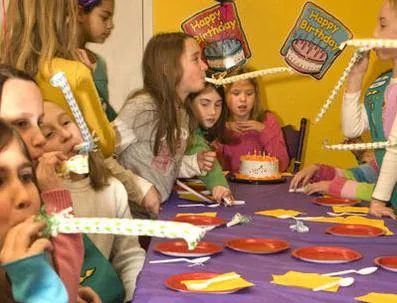
Photo: Parties-birthday.jpg: Kitetails derivative work: BD2412 T, CC BY-SA 3.0, via Wikimedia Commons
Every parent knows it. You hand a kid a slice of birthday cake, and twenty minutes later they're ricocheting off the walls. You watch it happen. You've seen it happen dozens of times. It's obvious, it's consistent, and it makes complete intuitive sense — sugar gives kids energy, energy makes kids wild.
Except that's not what's happening. And the evidence against it is about as solid as nutritional science gets.
The sugar-hyperactivity connection is one of the most thoroughly studied myths in pediatric health, and it has failed to hold up under scrutiny so many times, in so many different research designs, that scientists have largely stopped running the experiments. The answer is in. Sugar does not cause hyperactivity in children.
What's happening at birthday parties is something else entirely — and it's actually more interesting.
The Research Is Unusually Consistent
Scientific consensus on nutrition topics can be messy. Studies contradict each other. Sample sizes are small. Industry funding muddies results. But the sugar-hyperactivity question is an exception. The evidence is remarkably one-sided.
Researchers have been testing this since at least the 1970s, and the results have been consistent: when children consume sugar versus a placebo in controlled conditions — meaning neither the children, their parents, nor the observers know who got what — there is no measurable difference in behavior or activity levels.
A 1995 meta-analysis published in the Journal of the American Medical Association reviewed 23 controlled trials covering over 1,500 children and found no evidence that sugar affected behavior or cognitive performance. Some studies specifically tested children who had been diagnosed with ADHD, or children whose parents described them as 'sugar-sensitive.' Same result: no effect.
This isn't a case of inconclusive data or mixed signals. The studies looked for an effect and didn't find one, repeatedly, across different populations, different sugar types, and different research teams.
So What Is Actually Happening at the Birthday Party?
If sugar isn't the culprit, something is clearly going on at those parties. Kids are running around, shouting, barely sitting still, crashing hard by the ride home. Parents see this and the sugar on the table gets the blame. But consider everything else that's happening at a birthday party:
There are other kids — lots of them. Social excitement is a powerful behavioral stimulant. There are games specifically designed to get children moving. The environment is unfamiliar, stimulating, and loud. The event is a special occasion, which means normal rules and routines are suspended. Adults are distracted and less likely to redirect behavior. And yes, there's cake — but the cake is one element in a highly stimulating environment, not the cause of the environment itself.
Researchers call this a confounding variable problem. The sugar is present, the excitement is present, and humans naturally look for a simple cause-and-effect explanation. Sugar is visible, concrete, and easy to point to. 'Too much social stimulation at an event designed to be exciting for children' is harder to pin on a single thing.
The Psychology of Expectation
Here's where the story gets genuinely fascinating. A 1994 study by researcher Daniel Hoover and Richard Milich took a different approach to the question. They told a group of mothers that their sons had consumed a sugary drink before an observation period. They told another group of mothers that their sons had consumed a sugar-free drink. In reality, all the children had consumed the sugar-free drink.
The mothers who believed their children had consumed sugar rated their children as significantly more hyperactive during the observation period. They also hovered closer, made more physical contact, and were quicker to criticize behavior. The children's actual behavior was no different between groups — but the mothers' perception of it was.
This is the expectation effect, sometimes called observer bias, and it's powerful. When you believe sugar causes hyperactivity, you watch for hyperactivity after sugar. You notice the running and the shouting. You don't notice the five minutes of calm coloring that happened before the running started. Your brain is pattern-matching against a story you already believe.
And once you've 'seen' the effect enough times, the belief becomes self-reinforcing. No single birthday party is going to override a lifetime of confirmed expectations.
Why the Myth Has Such Deep Roots
The sugar-hyperactivity belief didn't appear out of nowhere. In the early 1970s, a physician named Benjamin Feingold proposed that food additives and certain natural compounds — including sugar — were linked to hyperactivity and learning problems in children. The 'Feingold diet' became enormously popular among parents, particularly those who felt that mainstream medicine wasn't taking their children's behavioral challenges seriously.
Feingold's hypothesis gave parents both an explanation and a sense of control. It said: this is why your child behaves this way, and here's something you can do about it. That's a psychologically powerful combination, and it spread widely through parent communities long before anyone had rigorously tested it.
Subsequent research found no support for the sugar component of Feingold's theory, though some food dyes and additives have shown more mixed results in studies. But by the time the science came in, the belief was already embedded in parenting culture. It had been passed from one generation to the next, reinforced by the expectation effect, and repeated so often that it felt like direct observation rather than inherited assumption.
The Takeaway
Sugar does not make children hyperactive. That's the science, and it's been the science for decades. What sugar at a birthday party does is arrive in the company of everything else that makes birthday parties stimulating — friends, games, excitement, loosened routines, and a room full of kids who are thrilled to be there.
The more interesting finding is what the expectation research reveals about how we observe the world. We see what we expect to see. We find what we're looking for. And when a belief is emotionally satisfying and socially reinforced, even solid evidence has a hard time getting a foothold.
Knowing the truth about sugar and hyperactivity probably won't change what you think you see at the next birthday party. But at least now you'll know what's actually running the show — and it's not the frosting.