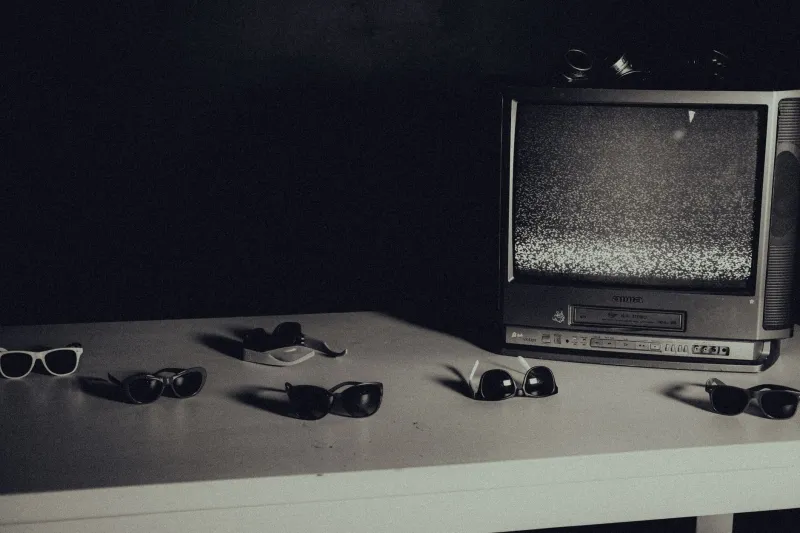
Ask someone over 70 whether they dream in color, and there's a decent chance they'll pause and say something like, "You know, I think mine are mostly black and white." Ask a 25-year-old the same question, and you'll probably get a confused look. Of course they're in color. Why wouldn't they be?
That generational gap turns out to be one of the stranger data points in sleep research — and it says less about human biology than it does about the power of the media we absorb every single day.
The Survey That Started Asking the Right Questions
For most of the 20th century, the idea that many people dreamed in black and white was treated as a straightforward fact. Sigmund Freud barely mentioned color in his dream analyses. Early sleep researchers largely accepted that dreams were grayscale experiences for a significant chunk of the population. Nobody seemed particularly suspicious of this.
Then researchers started doing something simple: they compared the responses across age groups and tracked them over time.
A study published in the journal Dreaming in 2008 by Eva Murzyn at the University of Dundee found something striking. Among participants over 55 who had grown up with primarily black-and-white television, about a quarter reported dreaming in black and white at least some of the time. Among younger participants who had grown up with color TV as the norm, that number dropped to just 4.4 percent.
The correlation was hard to ignore. As color television spread through American households — which happened rapidly through the 1960s and into the 1970s — the reported rate of black-and-white dreaming among younger generations quietly collapsed. It wasn't a gradual biological shift. It tracked almost perfectly with a technological one.
Why This Matters More Than It Seems
The obvious question is: were older generations actually dreaming in black and white, or were they just remembering their dreams that way?
This is where things get genuinely interesting. Dream recall is notoriously unreliable. When you wake up, your brain is reconstructing a memory of an experience that was never stored the way waking memories are. That reconstruction process is vulnerable to all kinds of interference — including, it appears, the dominant visual language of the culture around you.
People who spent their formative years watching black-and-white television, going to black-and-white movies, and flipping through black-and-white photographs may have been unconsciously filtering their dream memories through that same grayscale lens. The brain fills in gaps. It borrows from what it knows. And for a generation that associated "recorded experience" with monochrome imagery, that borrowing had real consequences for how they reported their inner lives.
This doesn't mean those older adults were lying or confused. It means human memory — especially memory of unconscious states — is far more porous and context-dependent than most of us want to believe.
The Bigger Problem With Dream Reporting
Sleep scientists will tell you that self-reported dream content is one of the least reliable data sources in all of cognitive research. We forget most of our dreams within minutes of waking. The ones we do remember are often the most emotionally intense or structurally unusual, which means they're not necessarily representative. And the act of describing a dream in words forces us to impose a narrative logic on something that may not have had one.
Color is particularly tricky. In the middle of a vivid dream, you're not usually cataloging sensory details the way you might during a waking experience. You're just in it. When you wake up and someone asks whether it was in color, you're being asked to retrieve a perceptual detail from a memory that was never encoded with much precision to begin with.
What fills that gap? Expectation. Assumption. Cultural context. The same mental shortcuts that make us so bad at eyewitness testimony.
So What Does This Say About the "Black and White" Myth?
The most likely explanation is that black-and-white dreaming was never a widespread biological phenomenon. It was a reporting artifact — a case where cultural exposure to monochrome media shaped how people described and remembered their dreams, not the dreams themselves.
That's actually a more fascinating conclusion than the myth it replaces. It suggests that the visual culture we're immersed in doesn't just entertain us. It subtly rewires the vocabulary we use to interpret our own inner lives.
Consider what that might mean now. A generation raised on hyper-saturated social media feeds, HDR video, and OLED screens reporting dreams that feel almost cinematically vivid. A generation that grew up watching grainy sitcoms on a 19-inch set in the living room reporting something flatter, quieter, less saturated. Neither group is wrong. Both groups are telling you something real — just not necessarily about their dreams.
The Takeaway
Black-and-white dreaming probably wasn't a biological reality for most of the people who reported it. It was a memory shaped by the dominant visual technology of their era. The myth persisted because nobody thought to ask whether the TV in the living room might be editing the theater in your head. It turns out the gap between what we experience and what we remember experiencing is a lot wider than most of us realize — and the stuff on the other side of that gap isn't always biology. Sometimes it's just whatever was on channel 4.