Scientists Quietly Ditched the 'Junk DNA' Story — What They Found Instead Will Blow Your Mind
The Textbook Tale That Fell Apart
For most of the late 20th century, biology students learned a neat story about human DNA: only about 2% of our genetic code actually mattered. The rest? Scientists called it "junk DNA" — evolutionary leftovers cluttering up our chromosomes like old files on a hard drive nobody bothered to delete.
This wasn't just some fringe theory. Major textbooks, university courses, and even Nobel Prize winners repeated this claim. The logic seemed solid: if DNA didn't code for proteins, what else could it possibly do?
 Photo: Nobel Prize, via www.nobelprize.org
Turns out, that question had a much more interesting answer than anyone expected.
When Scientists Actually Looked Closer
The story began changing in the early 2000s when the ENCODE project — short for Encyclopedia of DNA Elements — started mapping what our genome actually does on a daily basis. Instead of just cataloging which parts make proteins, researchers tracked where genes get turned on and off, where regulatory signals hide, and how different sections talk to each other.
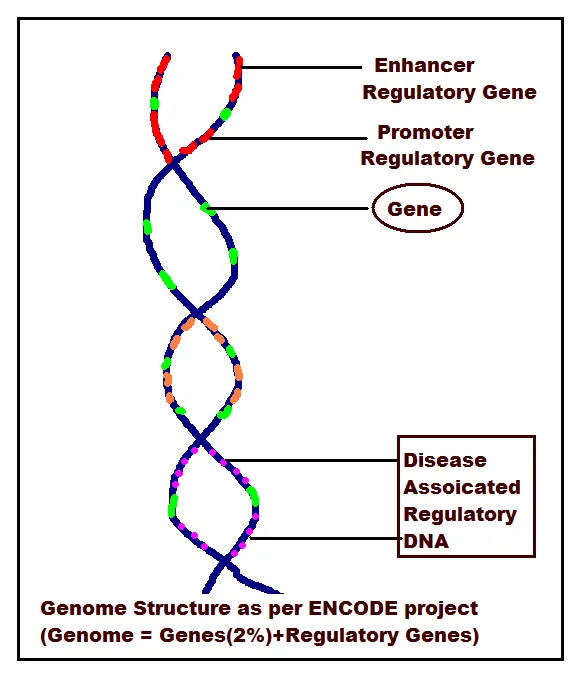 Photo: ENCODE project, via www.techdoubts.com
What they found flipped the junk DNA story completely upside down.
Rather than 98% waste, the ENCODE team discovered that roughly 80% of human DNA shows some kind of biochemical activity. Sections that don't code for proteins were busy doing other jobs: regulating when genes turn on, controlling how much protein gets made, and coordinating the complex cellular orchestra that keeps us alive.
Why the Junk Story Stuck Around So Long
The junk DNA narrative persisted for decades because it solved a genuine puzzle. Human cells contain about 3 billion base pairs of DNA, but only produce around 20,000 different proteins — not much more than a simple worm. If most DNA was just evolutionary baggage, that explained why we didn't need all those extra letters.
Plus, the protein-coding mindset dominated molecular biology for good reason. Proteins do the heavy lifting in cells: they speed up chemical reactions, provide structure, and carry messages. When scientists first learned to read DNA in the 1970s and 80s, finding the protein recipes felt like discovering the most important chapters in the book of life.
But that approach missed the regulatory networks hiding between the genes — the complex control systems that determine when, where, and how much of each protein gets made.
The Real Story Is Way More Complicated
Modern genomics reveals that our DNA operates more like a sophisticated control panel than a simple recipe book. Those non-coding regions contain:
Regulatory switches that turn genes on and off in response to environmental changes, development signals, or cellular stress.
RNA genes that produce functional molecules instead of protein blueprints — some of these RNAs help control other genes or participate directly in cellular processes.
Chromatin organizers that help package DNA efficiently and determine which genetic regions stay accessible for reading.
Evolutionary remnants that sometimes get reactivated to serve new functions, like old code that gets repurposed for different software.
The picture that emerges looks nothing like the simple junk vs. treasure division scientists once imagined.
Why This Matters Beyond Academic Curiosity
Understanding what non-coding DNA actually does has practical implications for medicine and human health. Many genetic variants associated with diseases like diabetes, heart disease, and mental illness fall outside protein-coding regions — in areas that were once dismissed as evolutionary noise.
These discoveries are helping researchers understand why identical twins with the same DNA can have different health outcomes, how environmental factors influence gene expression, and why some genetic therapies work better than others.
The ENCODE findings also explain some puzzling observations about human evolution. Our DNA is remarkably similar to that of other primates, but the differences in how genes get regulated — not just which proteins we make — might account for many uniquely human traits.
The Lesson Hidden in the Revision
The junk DNA story reveals something important about how scientific knowledge evolves. Sometimes the most confident-sounding explanations turn out to be oversimplifications that made sense with limited information but crumble when better tools become available.
The 10% brain myth and the junk DNA story share a common thread: both assume that evolution would keep around useless biological machinery for millions of years. In reality, natural selection tends to be pretty efficient at eliminating genuine waste.
Today's genomics researchers have largely moved past the junk DNA framework, but the term still pops up in popular science articles and introductory biology courses. The real story — that our genome contains layers of regulation and function we're still discovering — is messier than the old textbook version but far more fascinating.
The next time someone mentions junk DNA, you can share the update: scientists looked closer and found that our genetic code is busier than anyone imagined.